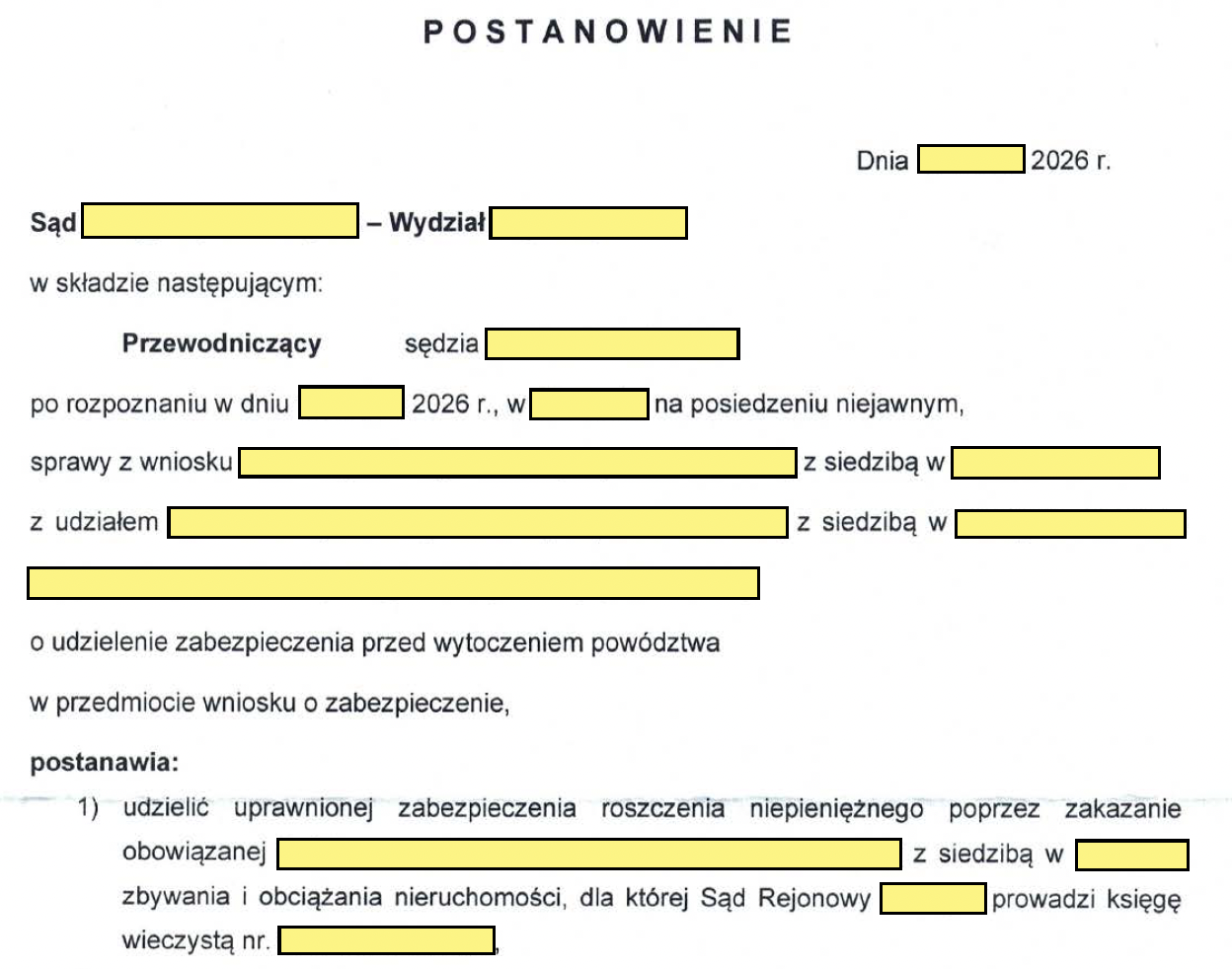
Securing claims: prohibiting the disposal and encumbrance of real property

Interim relief is one of the most powerful tools of civil procedure.
A court order granting interim relief regulates the parties' rights and obligations 'here and now', within a timeframe that is – by the standards of court proceedings – remarkably short. Overturning such an order, by contrast, usually requires the opponent to go through considerably lengthier interlocutory appeal proceedings.
Obtaining the desired interim measure for the duration of the trial can be of enormous significance for the further course of the dispute, given the length of court proceedings – which in recent years has been breaking all the wrong records.
In commercial practice, an important form of relief – and one frequently sought by clients – is an order prohibiting the respondent from disposing of and encumbering real property. By operation of specific statutory provisions, relief of this kind effectively prevents the respondent from transferring out of its estate real property which is usually the opponent's most valuable asset – the asset expected to allow the respondent's liabilities to be satisfied, or simply to constitute the subject of the future performance itself.
A prohibition on the disposal of real property is sometimes an indispensable and relatively frequently used form of security – for example, where an actio pauliana (a claim to set aside a fraudulent transfer) is brought.
More often than not, however, obtaining a prohibition on disposal and encumbrance is among the most difficult objectives that can be set at the interim relief stage. This is mainly because it is a measure that interferes deeply with the right of ownership and is potentially highly burdensome for the respondent.
Courts are particularly cautious about prohibiting a respondent from dealing with real property where the applicant is the respondent's mortgage creditor – that is, where the applicant's claim is already secured by a right which allows it to obtain satisfaction from the property regardless of who becomes its owner.
Even in that situation, however, obtaining the prohibition is not impossible – it requires the applicant to demonstrate, to the prima facie standard, special circumstances pointing to a risk of irreversible consequences that could threaten the applicant if the debtor were to dispose of the property.
In one of our cases, a regional court granted our client interim relief in the form of a prohibition on disposing of and encumbering real property even though the applicant not only held a first-ranking mortgage over the property, but the property had also already been attached for the applicant's benefit in enforcement proceedings.
Although under Article 930 § 1 of the Polish Code of Civil Procedure a disposal of real property after its attachment does not affect the further course of the enforcement, in practice a potentially fraudulent transfer of the property may result in, at the very least, serious obstruction of further enforcement steps.
The court shared the applicant's concern that the debtor's conduct to date gave rise to a risk that it might transfer ownership of the property to a third party in order to abusively stall the enforcement – for example, through the tactical opening of restructuring proceedings by the property's new owner.
The order obtained shows that even a seemingly very well-secured creditor may have a genuine legal interest in obtaining a prohibition on the disposal and encumbrance of real property.